

The need for control is a behavioral trait many of us, as leaders, are gifted – or cursed with, depending on perspective. To some extent, we all have a need for control. Certainly, when directed at our own actions, control represents agency – the ability to shape one’s life with autonomy.
Lately, I have been reminding quite a few clients of a tool, the Circle of Influence, popularized nearly 40 years ago by Stephen Covey. In this simple model, we consider the things that are worrisome, frustrating, or confounding, and place them in one of three concentric circles. The outer circle represents things we have no influence over, but that might impact us: decisions and choices made without our input and held steadfastly. One way of thinking about these items is that they are things we can worry about but can’t do anything about. The middle circle represents the things over which we have no direct decision-making authority but can still influence. We might have expert input, a vote, or an opportunity to persuade. The inner circle (perhaps the smallest on the diagram for a reason) contains those things we do, in fact, control, and thus can autonomously choose, change, or direct.
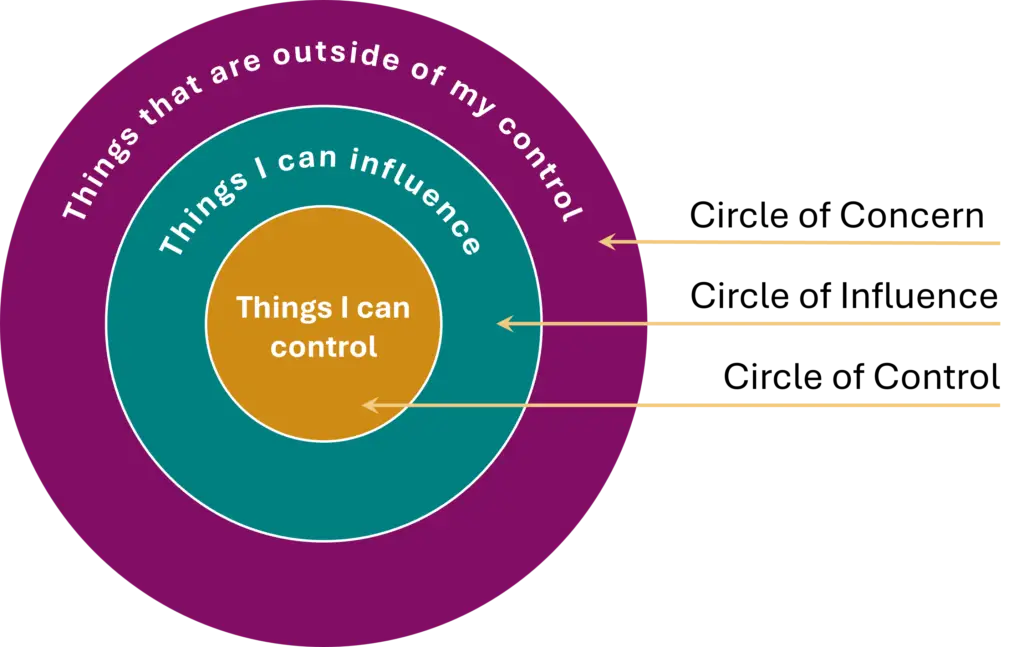
If you do this exercise, you might discover that most of the things in the innermost circle involve your own thoughts and actions. We cannot control others, at least not to a very large extent. If you concede to this reality, you’ll have a lot of items in the other two circles.
I find that the decisions we make about where to place items on the Circle of Influence are directly related to the amount of peace in our lives – as well as our success.
On a practical basis, let’s say that at least some part of your job does not depend on positional authority – that is, in order to mobilize change or obtain a decision that is, in your assessment, in the best interest of the organization, you must influence one person or many. In my experience, how we view these items – our mindset about control – impacts our behavior. If we believe we do (or should) control what is in fact someone else’s decision to make, we might not employ the finer skills of influence, relying only on superior subject-matter expertise up to the point of argument. If we don’t believe we have the influence we actually have, we might not even attempt it. Either way, the outcome suffers. And, if we fail to understand the difference between what is truly in our control vs. what resides in the other two circles, we most certainly do not find peace. Instead, we have stress and frustration.
In this important discernment exercise, make peace with the outer circle. If there are things in the inner circle you are not attending to, prioritize them and act if needed. Then, focus on the middle circle. If the items there speak to what’s “right”: your values, or the mission you support, consider how you will seek to influence without alienation. Once you put forth effort, you might find that the final result or decision now lies in the outer circle. The act of letting it go once again brings peace.